

New Telescopic Rails For Aircraft Interiors Reduce Weight

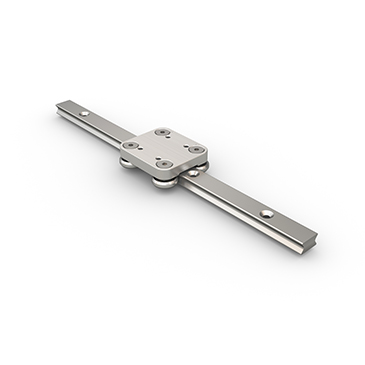
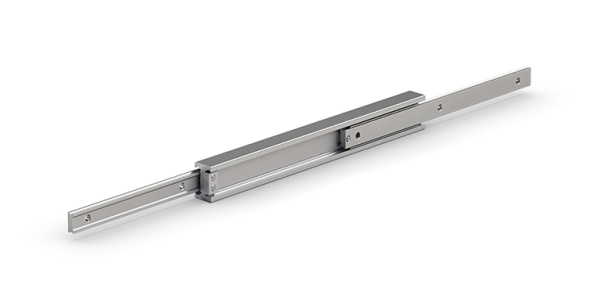
In aircraft seating, every ounce counts. And as first and business seats grow more complex, it’s increasingly difficult to meet weight targets. Our new DE Series telescopic rails can help.

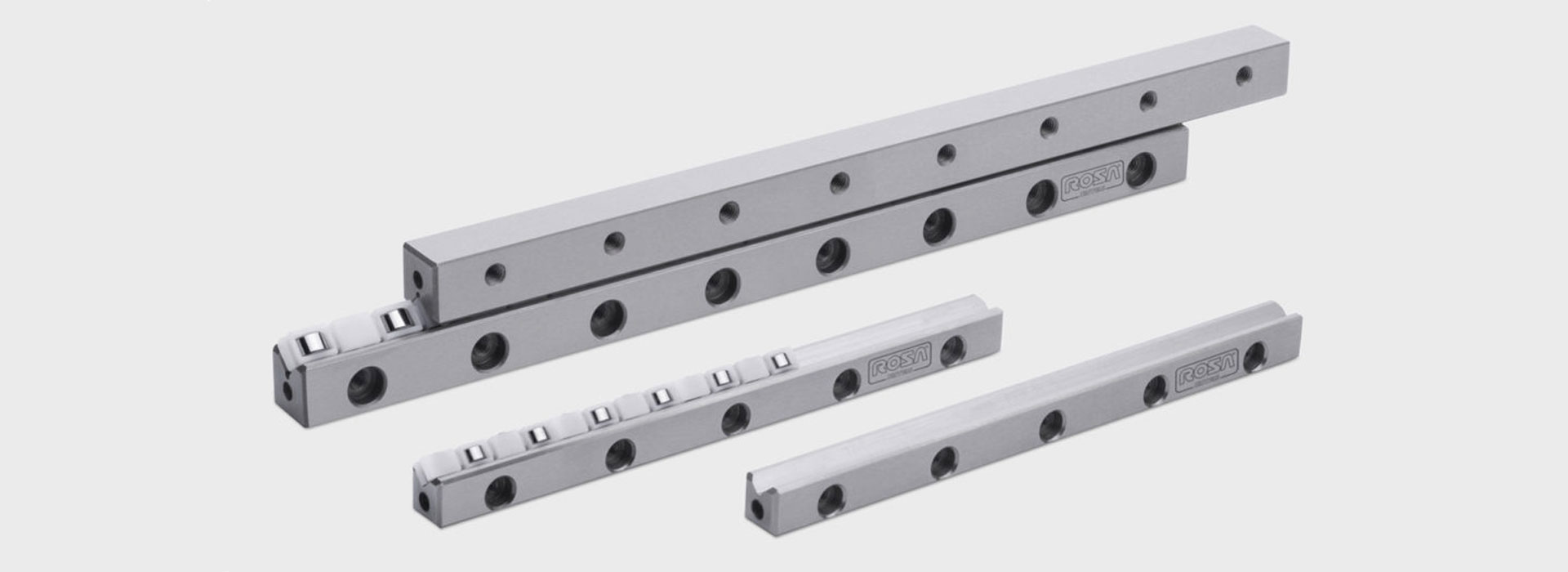
Weighing 30% less than our standard telescopic rails, the DE Series can support the movement of seat pans, footrests, armrests and pull-out tables on first and business class seats.

Our engineering team achieved this significant weight reduction by optimizing the rail profile thickness.  The optimization took out excess material from the rail while preserving the long lifecycle, limited deflection, smooth motion, compact form factor and load carrying capacity that characterize all our telescopic rails.

Long Life, Fully Loaded.  Thanks to our design optimization, the lightweight DE Series rails can still run for tens of thousands of cycles even under maximum load.  That maximum load is roughly 130 kg applied to the end of a fully extended rail.

Tolerates Misalignment. Like our standard telescopic rails, DE Series rails can self-align to their mounting surfaces. This capability allows the rails to tolerate deflection of their mating components without diminishing smooth operation.

To see the new DE Series in person, visit us at the Aircraft Interiors Expo, April 9-11, in Hamburg, Germany. We’re in Hall B6, Stand 6C37.

Avoid Actuator Overkill, Control Costs

When engineers design motion control systems, they sometimes commit a costly error known as actuator overkill. As its name suggests, this error involves the selection of actuators whose precision, speed, lifecycle or other technical capabilities exceed the true application requirements.

Actuator overkill can occur in many types of applications, but you often see it in pick-and-place systems. To be sure, some pick-and-place devices need every incremental bit of accuracy, precision, speed or lifecycle that a high-end actuator can deliver. Many pick-and-place devices, however, do not need the very best actuators. In these cases, selecting a middle-of-the-road actuator will help you get the most out of your motion control dollars.

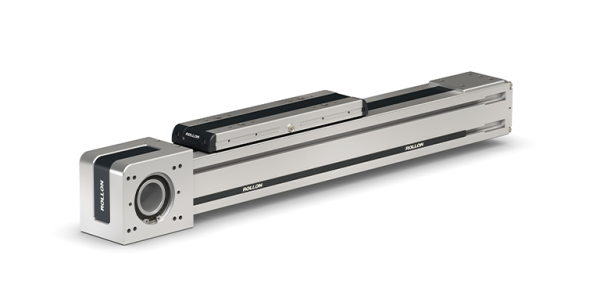
Our ActuatorLINE™ E-Light Series is a case in point. In the right applications, this belt-driven actuator can cost as much as 30-40% less than our top-of-the-line ELM Series.

So what are the right applications for these cost-saving actuators?

When Light Is Right. ActuatorLINE E-Light excels in applications that can be satisfied with a lower level of precision and accuracy compared with a high-end actuator model—such as those in our ELM Series. For example, an ActuatorLINE E-Light model will have a repeatability of 100 µm versus 50 µm for a comparable ELM actuator. In applications such as a packaging pick-and-place device, this precision tradeoff will typically make no practical difference whatsoever.

The “light” in ActuatorLINE E-Light refers to the weight of the aluminum structural elements, not the load bearing capacity. So our Light Series handles the same loads as comparable ELM models. There is, however, a potential reduction in lifecycle under some speed and environmental conditions. Again, in many applications, the lifecycle tradeoff will not rule out the use of the more economical E-Light actuator.

ActuatorLINE E-Light also features some integration advantages that make it especially attractive
in custom machines. It supports:

  • Gearbox installation on either side of the unit and either end of the actuator.
  • Custom machining of carriage top plates.
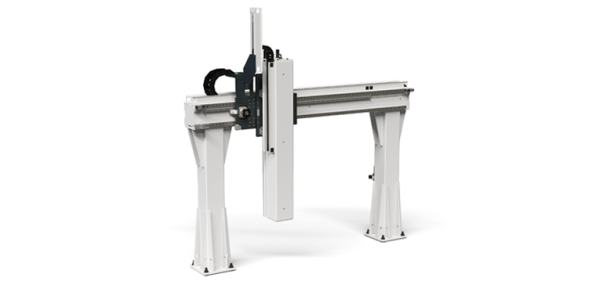
  • Connection kits to create X-Y-Z Cartesian robots.
  • Adjustable end-of-travel sensors.

When Light Isn’t Right. ActuatorLINE E-Light isn’t for every application. You would expect to step up to ELM models or even our T-Series ballscrew actuators in applications needing the maximum precision or lifecycle rating. They include most electronics assembly applications as well as some precision machining operations.

Finally, our ELM models are the clear favorite in applications that require stringent cleanliness or contamination resistance. ELM actuators have contaminant protection, food grade lubrication and stainless steel shafts, bearings and component parts options that the E-Light Series lacks.

Still not sure whether your application can be successful with our ActuatorLINE E-Light Series or whether you need to take it up a notch in performance? Contact one of our technical service engineers for help.


Heavy-Duty Linear Actuators For Multi-Axis Jobs

Linear motion applications often involve heavy-duty, multi-axis manipulation of heavy loads at high speeds. A prime example would be palletizing equipment, but many applications have similarly intense motion requirements.

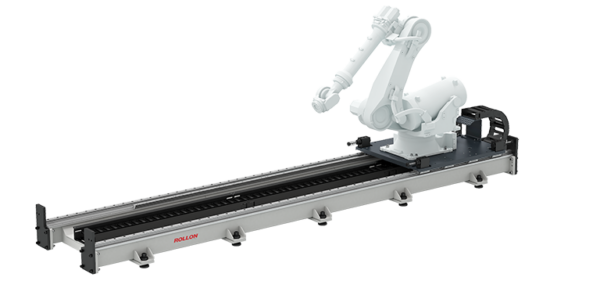
To meet the needs of these heavy-duty, multi-axis linear motion tasks, we’ve introduced the ROBOT Series of linear actuators. They feature:

Strong, Rigid Construction. ROBOT units are made of anodized aluminum extrusions for high mechanical strength and low weight. These sturdy actuators also include a steel-reinforced polyurethane timing belt with either an AT pitch or parabolic profile suited to high-speed operation.

A variety of setups are available to meet different application needs. ROBOT SP units feature two ball bearing guides mounted in two seats on the outer sides of the body. The carriage is assembled on four preloaded ball bearing blocks, enabling it to withstand loading in the four main directions. The ROBOT-2C Series features two carriages on the same unit, with the possibility of a fully independent drive.

Choice of Drive Systems. Depending on the end use, ROBOT units may be fitted with a variety of drive systems. The driving pulley is attached to the reduction gear shaft by a tapered coupling to ensure high accuracy and long life.

  • Standard models are available with clearances from 3 to 15 ft. and reduction ratios of 1:3 to 1:1,000
  • Versions with planetary gears are ideal for highly dynamic robotic, automation and material handling applications involving stress cycles and high-precision requirements
  • Versions with worm gears are perfect for applications involving low speeds and accelerations

Multi-Axis Motion. Some applications call for multiple-axis setups. In these cases, a specialized set of fittings with brackets and cross plates easily connects ROBOT units to each other and to SC and ELM units within the ActuatorLINE family.

Multiple Sizes. Demanding linear motion systems often require customized configurations, not a cookie-cutter approach. That’s why we offer the ROBOT Series in a range of sizes and load capacities. All ROBOT SP actuators offer speeds to 5 m/s, high load capacity and bending moments, low friction and a service life of 20,000 km without re-lubrication.

  • Body dimensions measure 55 x 100 mm, 70 x 130 mm, 90 x 160 mm and 100 x 220 mm
  • Maximum dynamic axial load capacities from 780 to 5,510 N
  • Stroke lengths from 100 to 6,000 mm
  • Actuators support loads in any direction and may be installed in any position

Vertical Applications Call For Specialized Linear Actuators

Setting up a dynamic, high-speed linear motion system is challenging enough. Flip it 90° to go vertical, and things get even trickier. In theory, linear actuators should work in any orientation. However, in real-world installations, cables can become tangled and moving parts can shift unexpectedly. To meet the specific needs of challenging vertical applications, we’ve introduced SC Series linear actuators as part of our new ActuatorLINE family.

SC units are built with anodized aluminum extrusions for high mechanical strength and low weight. The robust actuators also include a steel-reinforced polyurethane timing belt with either an AT pitch or parabolic profile suited to high-speed operation.

Streamlined Design. With the SC Series, tangled lifelines are a thing of the past. That’s because the drive is fitted directly onto the fixed carriage, eliminating cable movement, so the aluminum profile is the only moving part. In fact, the carriage itself houses the entire linear motion system, consisting of a drive pulley and two driven pulleys. Side slots enable quick and easy mounting of accessories, such as proximity switches, while power cables and air hoses may be passed inside the body. The carriage is assembled on four preloaded ball bearing blocks, enabling it to withstand loading in the four main directions.

Fast and Sturdy. Vertical applications such as those found in the robotics and material handling industries often demand punishing speeds. The SC Series is designed for just such environments. SC actuators offer speeds to 5 m/s, acceleration to 50 m/s2, high load capacity and bending moments, low friction and a maintenance-free lubrication system. For additional protection against contaminants, the carriage is fitted with specialized seals.

Range of Sizes. A one-size-fits-all approach is not very useful when it comes to challenging vertical applications. That’s why the SC models come in three sizes.

  • Body dimensions measure 65 x 65 mm, 70 x 130 mm and 90 x 160 mm
  • Maximum dynamic axial load capacities from 820 to 3,700 N
  • Stroke lengths from 100 to 2,500 mm
  • Actuators support loads in any direction and may be installed in any position

Drive System Flexibility. The drive system of choice will be determined by the specific application. The SC series is designed for ultimate versatility.

  • Standard models are available with clearances from 3 to 15 ft. and reduction ratios of 1:3 to 1:1,000
  • Versions with planetary gears are ideal for highly dynamic robotic, automation and material handling applications involving stress cycles and high-precision requirements
  • Versions with worm gears are perfect for applications involving low speeds and accelerations
  • SC linear units may also be equipped with simple or hollow shafts

Multi-Axis Motion. Certain applications call for multiple-axis setups. In these cases, a specialized set of fittings with brackets and cross plates connects SC units to each other and to ROBOT units within the ActuatorLINE family.

ELM Series Actuators Enable Fast, Quiet, Versatile Motion

Making its official debut at the IMTS Show in September, the ELM series of linear actuators is the first member of our new family of ActuatorLINE products. Tested and proven in the European market, versatile ActuatorLINE units are now available to North American engineers looking for more options in linear motion design.

Multiple Sizes Available. There’s nothing worse than finding the perfect actuator and discovering it only comes in a few sizes, none of which fit for your application. The ELM series is available in several sizes, offering a range of stroke lengths, load capacities and speeds to meet a diverse range of application needs. Continue reading

TT Series Positioning Stages Deliver High-Precision Motion

From semiconductor manufacturing to machine tools, highly precise linear motion determines the success of many demanding applications. To address today’s needs for precise and accurate motion control, we announce the ActuatorLINE TT series of high-precision linear positioning stages. Available in a range of sizes and configurations, these hardworking stages are ideal for use in:

  • Robotic handling systems
  • Semiconductor equipment
  • X-Y-Z Cartesian robots
  • Machine tools
  • Automated assembly lines and more

Strong and Precise. Every aspect of the TT series linear positioning stages is designed with precision in mind. For starters, stages are made of anodized aluminum extrusions for high mechanical strength and low weight. To guarantee precise movement, bodies are CNC machined on all outer surfaces and where mechanical components are attached, such as ball bearing guides. Continue reading

New Actuators Complement Our Linear Guides

Rollon’s Actuatorline Debuts at IMTS in September.

Many an engineering hour has been spent cobbling together motion systems from individual components that may not have been designed or sized to work together properly. Our own engineers and our customers cope with these mismatched-components from multiple sources problem every day–but not for much longer.

Starting next month, we will offer a complete line of actuators to complement our linear guide offerings and transform Rollon USA into a systems supplier.

Continue reading

New Facilities, New Capabilities

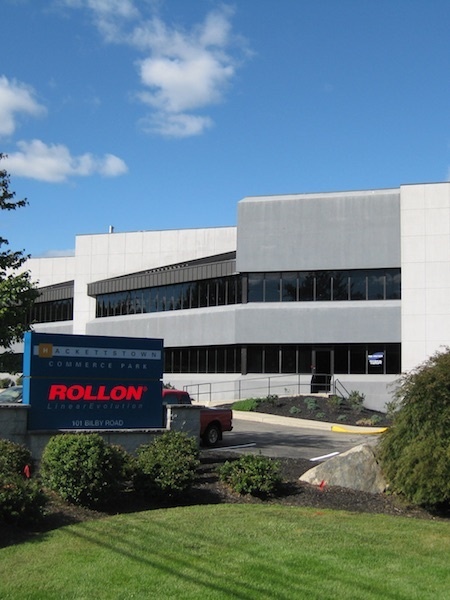
101 Bilby Road, Hackettstown, NJAll of the engineers and technicians here at Rollon USA are big believers in continuous improvement. So when we had the opportunity to move to a superior manufacturing facility this year, we jumped at the chance.

At nearly 22,500 square feet, our new facility nearly doubles the amount of space we have at our disposal. We’ve put that extra real estate to good use, expanding and improving a variety of manufacturing operations. These include: Continue reading

Self-Aligning Linear Guides For Aircraft Seating

Lay flat seats make the skies friendlier with some help from the right linear guides

If you’ve been lucky enough to fly business or first class on an overseas trip, you may have noticed just how complex the seats have become from a linear motion standpoint. The most advanced seats now fold completely flat and offer numerous neck, back, and leg adjustments.

These super seats, which consist of up to 5,000 parts and cost more than $250,000 each, can incorporate as many as 8 different linear guides. A couple of technical key factors have emerged as the most important when selecting linear guides for seating applications. Continue reading

Rollon Linear Guides for the Train Industry

To keep the trains running on time, it makes sense to pay attention to the linear guides used throughout today’s railroad and mass transit cars.

Linear guides may not make an obvious contribution to the uptime of rolling stock, but they do play a crucial role in the operation of doors, access panels, seats and stowage systems. When linear guides fail, they can bring train to a halt as surely as a broken engine.

One way to avoid unnecessary failures is to pick reliable linear guides that are:

  • Corrosion resistant. Exterior doors and access panels, in particular, need to withstand corrosion and must pass rigorous salt-spray tests before even being considered for use in railway applications.
  • Contamination tolerant. Exposed or partially exposed linear guides have to tolerate a wide spectrum of human and environmental contaminants, including unusual ones such as hair.

Rollon supplies nine distinct linear guide styles to meet varying force, duty-cycle, integration and environmental requirements.


For a look at some strategies for fighting linear guide corrosion in railroad and mass transit applications, download our latest white paper.

Understanding Installation Differences

Compact Rail

Machine builders are sometimes reluctant to switch from one type of linear guide to another because of perceived installation differences. The truth is, though, that these differences tend to be minor and may even bring some unexpected benefits. For a case in point, consider what’s involved when switching from a ball-rail linear guide to Rollon’s Compact Rail.

The Compact Rail can replace any similarly sized ball-rail guide within the size, load and accuracy constraints described in the last post. Think of Compact Rail as a potential replacement for ball-rail guides.

Continue reading

Linear Guide Alternatives

Compact Rail

In all too many applications, engineers still pick linear guides based on familiarity rather than true accuracy, load and size requirements. And all too often, the most familiar linear guides are recirculating-ball styles with the longest lead times. Even a cursory needs analysis, however, will show that the majority of linear motion requirements can be easily met with advanced roller-style linear guides, such as Rollon’s Compact Rail.

Here are some specifics that can guide help you decide when an application needs can be satisfied with a lower-cost, readily available Compact Rail product–and when they can not: Continue reading

Avoiding Long Delivery Times

TelescopicNot all linear guides are created equal when it comes to delivery times. The highest-precision classes of linear guides usually have dramatically longer lead times, especially at lengths beyond 1240 mm.

For some axes of motion, the most precise guideways are indeed a necessity. But expensive precision products are routinely applied to axes that have less stringent motion requirements. Machine builders have in the past often specified one type of linear guide, usually a recirculating ball type, for use throughout the machine. This approach, while convenient, is no longer sensible or cost effective. Continue reading